
Where Clean Oil Gets Dirty
Oil can be contaminated during receiving, storage, transfer and filling. Sampling can also contaminate the bottle or make the result unrepresentative. Follow one lubricant route, then inspect the sampling method separately.

In this article
Cleanliness is usually lost at an opening. It may happen when a drum arrives with a damaged seal, when a transfer container is left uncapped or when oil is poured through a shared funnel. Sampling creates a different risk: dirt can enter the bottle and mislead the diagnosis even when the machine oil has not changed.
Walk one lubricant from receiving to one critical machine. At each handoff, record the product identity, every place the route is opened and the method used to close it again. Then inspect sampling separately so a contaminated bottle is not mistaken for dirty machine oil.
This article covers contamination introduced during receiving, storage, transfer and filling, together with errors introduced during sample collection. Wear debris, seal ingress, oxidation products and other contamination generated inside the machine require separate monitoring and control. 1
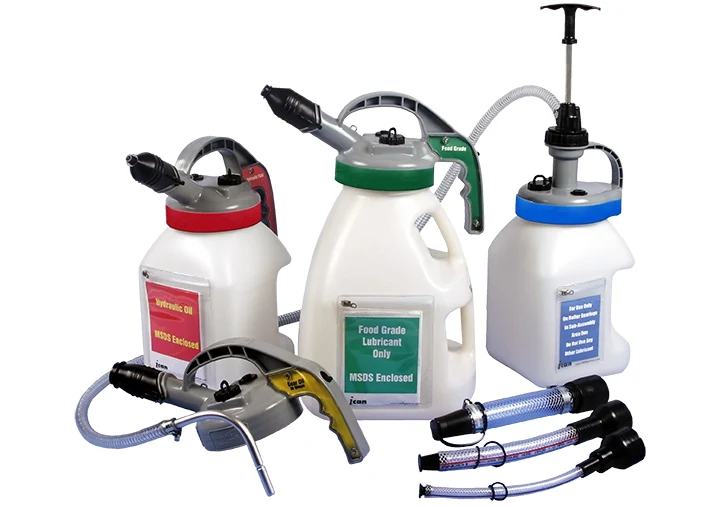
Before blaming the supplier or the machine, establish whether the contamination belongs to the delivered oil, the operating system or the sample bottle.
New oil is not proof of clean oil
New oil has not yet served in the machine. That does not prove it meets the cleanliness or moisture requirement of a sensitive asset. Packaging, transport, storage and dispensing can all affect the condition in which the lubricant reaches the machine. 2
The answer is not to send every delivery to a laboratory. It is to define what the machine needs, verify product identity every time and make the depth of condition testing proportionate to asset criticality, supplier performance and the consequence of an error.
A complete acceptance requirement defines
- The lubricant identity
- The condition parameter and test method
- The acceptance limit
- The sampling location and sampling condition
- The action required when the result is outside the limit
- The person authorized to release, filter, quarantine or reject the oil
ISO 4406:2021 provides a code for reporting solid-particle contamination in hydraulic fluids. It does not select the cleanliness target for a particular asset. That target must reflect component sensitivity, lubricant type, operating environment and the consequence of failure. 3
Follow the lubricant route
A particle count cannot show you the uncapped container behind the lube room door. For that, you need a plant walk. Start where the lubricant arrives, follow one product to one important machine and record the control and verification at every stage.
| Stage | Common failure or exposure | Primary control | Verification |
|---|---|---|---|
| Receiving | Damaged seal, wrong identity or unacceptable condition | Identity check, inspection and defined release process | Release record or representative sample |
| Storage | Open connections, unprotected tools or misidentification | Capped and clearly identified equipment | Routine visual audit |
| Transfer | Shared funnel, open bucket or previous lubricant residue | Dedicated closed-transfer equipment | Observe the complete transfer |
| Machine filling | Exposed fill point | Dedicated closed fill connection | Confirm there is no open pour |
| Reservoir | Uncontrolled air exchange or repeated opening | Selected breather and inspection hardware | Condition and inspection record |
| Sampling | External contamination enters the bottle, or the method changes | Dedicated point, clean bottle and documented flushing method | Complete sample record and comparable repeat result |
Lubricant route audit
01Receiving
- Common failure or exposure
- Damaged seal, wrong identity or unacceptable condition
- Primary control
- Identity check, inspection and defined release process
- Verification
- Release record or representative sample
02Storage
- Common failure or exposure
- Open connections, unprotected tools or misidentification
- Primary control
- Capped and clearly identified equipment
- Verification
- Routine visual audit
03Transfer
- Common failure or exposure
- Shared funnel, open bucket or previous lubricant residue
- Primary control
- Dedicated closed-transfer equipment
- Verification
- Observe the complete transfer
04Machine filling
- Common failure or exposure
- Exposed fill point
- Primary control
- Dedicated closed fill connection
- Verification
- Confirm there is no open pour
05Reservoir
- Common failure or exposure
- Uncontrolled air exchange or repeated opening
- Primary control
- Selected breather and inspection hardware
- Verification
- Condition and inspection record
06Sampling
- Common failure or exposure
- External contamination enters the bottle, or the method changes
- Primary control
- Dedicated point, clean bottle and documented flushing method
- Verification
- Complete sample record and comparable repeat result
Receiving: verify identity, condition and release status
Verify the container condition, seals, lubricant identity, viscosity grade, batch information and required documentation before the delivery enters general storage. For critical lubricants, define whether the batch requires sampling, filtration or quarantine before release. The level of condition verification should reflect asset criticality, supplier performance and the consequence of an error.
Storage: make the right action the easy action
Keep each container, lid, hose and connector protected when it is not being used. Give each lubricant family clearly identified tools. Colour helps a technician recognise the route at a glance, but the written lubricant identity should remain the primary control. Store caps on the equipment or in a protected holder at the point of use. A loose cap kept elsewhere is less likely to be refitted promptly and may itself collect contamination.
Transfer: remove the need to improvise
Shared funnels and open buckets are familiar, fast and cheap. They also expose the lubricant to dirt, moisture and whatever the tool handled last. The value of a purpose-built transfer container is not the container alone. It is the ability to keep the lubricant closed, correctly identified, chemically compatible and controllable from storage to the fill point.
- Sealable, clearly identified and compatible with the lubricant
- Easy to clean, with protected inlet and outlet points
- Matched to a suitable connector or dispensing method
- Dedicated by lubricant family or an approved application
The machine: protect the last metre
A clean transfer can still end at an exposed fill point. For example, a closed transfer container becomes an open process if the operator must remove a large reservoir cover and pour through an exposed opening. A dedicated fill connection preserves the control established during storage and transfer.
Control the air entering the reservoir
A vented reservoir exchanges air with its surroundings as oil level and temperature change. In a dusty or humid area, an open vent gives airborne particles and moisture a direct route to the lubricant.
A breather should be selected for the expected airflow, humidity, ambient temperature, duty cycle, connection and fluid compatibility. An undersized or incorrectly applied breather can restrict airflow or provide inadequate protection. 4
A sight glass lets the operator check level, clarity, foam and obvious free water without opening the reservoir. It provides visual clues. It does not confirm particle cleanliness, dissolved water concentration or lubricant chemistry.
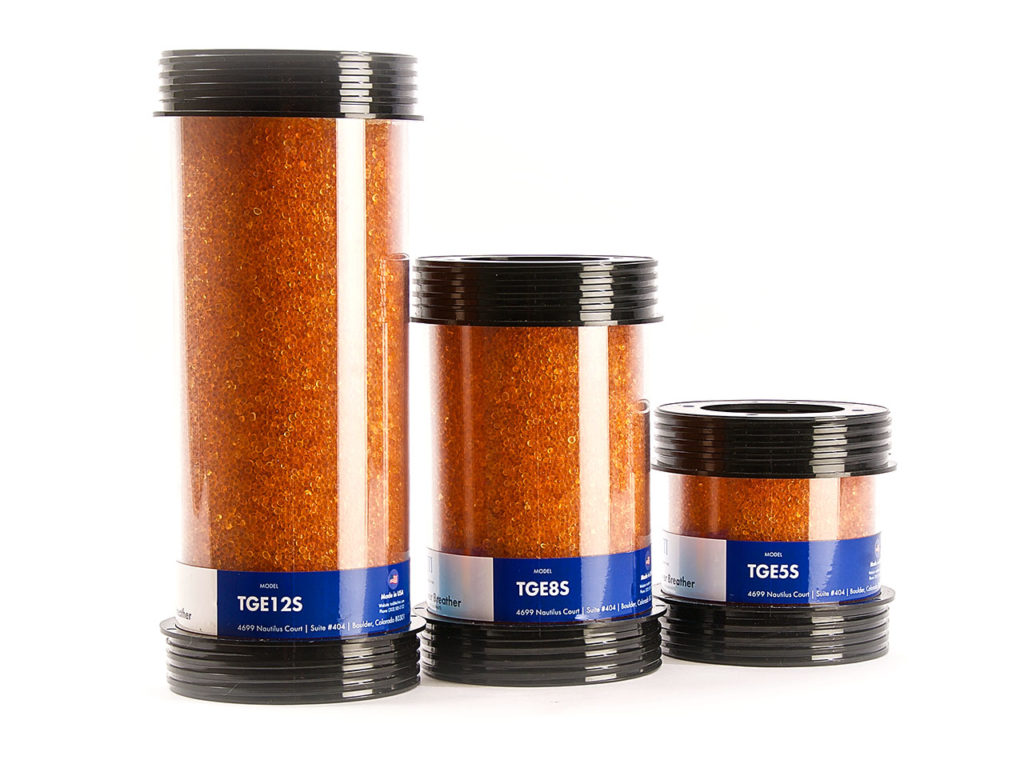
Breathers exclude. Filters remove.
A breather controls one ingress route. A particle filter removes suspended solids only from the oil that passes through it. The functions are complementary, not interchangeable.
A breather limits contamination entering with exchanged air. A particle filter cart removes suspended solids from the fluid passing through it. Water removal may require a different purification method, depending on whether the water is free, emulsified or dissolved. 5
Select the cleanup method around the contaminant type and concentration, lubricant compatibility, viscosity at operating temperature, flow path, reservoir volume and target condition. Then verify the result using the same representative sampling method used for the baseline.
Keep routine samples comparable
A laboratory trend is only as consistent as the sample behind it. If the point, machine state or flushing practice changes, the result may answer a different question.
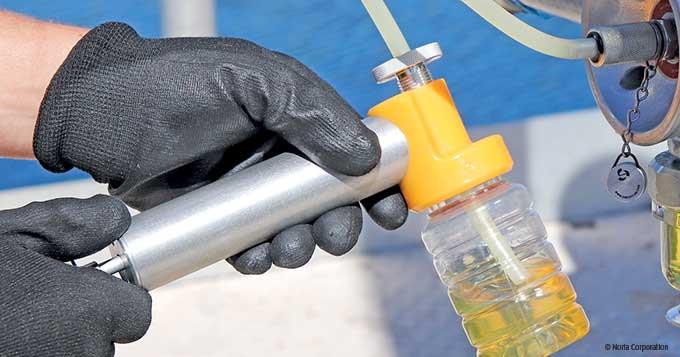
Select the sampling point to match the decision the sample must support. For routine trending, keep the point, machine state, flushing method, bottle preparation and timing consistent. In hydraulic systems, a suitable main-flowline point is preferred for representative particulate sampling. Record every departure from the method. 6 7
A drain sample can be useful when investigating settled debris or contamination at the bottom of a reservoir. It should not be mixed into a routine trend built from a representative live-zone sample point.
For a comparable routine sample
- Sample from the same representative point
- Use the same operating condition
- Flush the point using the documented method
- Use the specified clean bottle
- Cap and label the sample immediately
- Record the machine state and sampling context
Choose the first gap to close
Begin with one frequently used lubricant and one machine where failure matters. Walk the route with the people who receive, store, carry, fill and sample the oil. The goal is not to collect the longest list. It is to find the opening that creates the greatest risk.
Five questions will usually reveal where control is being lost:
- Are the product identity, seals and acceptance requirements clear at receiving?
- Can the lubricant remain closed and correctly identified in storage?
- Can it reach the fill point without a shared funnel or open pour?
- Can operators inspect the reservoir without opening it?
- Can another technician repeat the sampling method and obtain a comparable result?
Route priority screen
This is a field conversation aid, not a calculated risk model.
How often is the route opened, shared or left uncapped?
Is the route physically closed, or does control depend on memory?
What happens if particles, water or the wrong product reach this asset?
Can an inspection or comparable sample show whether the correction worked?
Act first where frequent exposure meets serious consequence and the present control is weak. Record the judgment and the evidence behind it.
Do not automatically fix the first weak answer. Compare the route gaps with what the team knows about the asset, assign an owner and standardize the chosen correction. Verify its effect using the same sampling method.
Before calling the fix proven, record
- The asset, lubricant and documented requirement
- The baseline result and representative sampling method
- The observed route gap and control introduced
- The owner, implementation date and follow-up result
Use genuine plant data. A neat story is not evidence if the baseline and follow-up were collected differently.
Close the first visible opening
Start at receiving and follow one lubricant to one machine. If the route requires an open bucket, a shared funnel or removal of a reservoir cover, the weakness is visible before a laboratory result arrives. Close that opening, document the method and use comparable samples to check whether oil condition improves.
Route questions
Can new oil go straight into the machine?
It may already meet the asset requirement, but new is not evidence on its own. Define the target, verify critical deliveries and filter during transfer when the result or equipment requirement calls for it.
Can a filter cart replace a desiccant breather?
No. Particle filtration removes suspended solids from the fluid. Water and other contaminants may require different treatment methods. A breather controls contamination entering with exchanged air, so neither device replaces the other.
Does a sight glass confirm that the oil is clean?
No. A sight glass can reveal level, foam, cloudiness or obvious free water, but it cannot confirm particle cleanliness, dissolved water or lubricant chemistry.
How often should incoming oil be tested?
There is no universal frequency. The receiving plan should reflect asset criticality, delivery method, supplier history, lubricant sensitivity and the consequence of releasing unacceptable oil.
Is colour coding enough to prevent lubricant mix-ups?
No. Colour is a secondary visual aid. The written lubricant identity should remain the primary control.
Can the same filter cart be used for different lubricants?
Only when compatibility, cleaning and contamination-control procedures have been defined. Residual fluid can turn a shared cart into a cross-contamination route.
Why not take every routine sample from the drain?
A drain sample can help investigate settled debris, but it may not represent the oil moving through the active system. Keep routine trend samples at the same representative point when the machine design and procedure allow it.
References
View 7 technical references
- Donaldson. Six types of hydraulic fluid contamination and how they enter a system.
- Donaldson. How to prevent hydraulic system contamination during storage, transfer and operation.
- ISO 4406:2021. Method for coding the level of contamination by solid particles.
- Des-Case. Standard desiccant breather application and sizing considerations.
- Pall. Particle contamination control and fluid purification methods.
- ASTM D8112-26. Standard Guide for Obtaining In-Service Samples of Turbine Operation Related Lubricating Fluid.
- ISO 4021:1992. Hydraulic fluid power, particulate contamination analysis: extraction of fluid samples from lines of an operating system.
Equipment requirements and application limits take priority. Confirm material compatibility, connection size, flow, operating conditions and the documented procedure before installation or sampling.
New LubeServ articles
Get new LubeServ articles by email
We will email you only when a new article is published. Unsubscribe at any time.