
Patch testing
The Darker Patch May Have Seen More Oil
A darker oil patch can reflect a larger test volume. Read the preparation record, compare like with like and choose the evidence needed before ordering filtration.

Keep the preparation record with it.
Before a darker patch photograph becomes a filtration job, ask for one number: how many millilitres of oil went through the membrane?
A membrane prepared from 100 mL has seen four times the oil used for a 25 mL patch. Even oil from the same well-mixed bottle can leave a different-looking deposit when the test changes. The first job is to establish whether the two patches can be compared.
Keep the material. Keep the photograph. Recover the preparation record before deciding what either says about the machine.
Read the volume before the colour
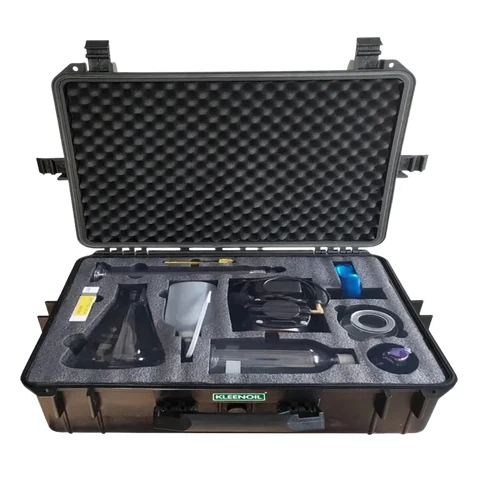
A patch test concentrates retained material onto a membrane. The LubeServ Patch Test Kit brings the filtration equipment together in a carrying case, with an optional microscope for a closer look. Its useful output is material that can be examined and kept, rather than another view of oil dispersed through a bottle.
For the same homogeneous oil, the same collection area and equal retention of the particles being considered, filtering four times the volume gives four times the expected retained loading. That is a quantity relationship. It is not a rule that the membrane becomes four times darker.
Read the mechanism
The input changed before the membrane did.

The collection area matters as well. Spread the same retained amount over a different area and the deposit is presented differently. A membrane’s nominal diameter does not by itself establish the exposed filtration area in the holder. Keep the specified membrane and holder arrangement with the method.
Particle size, colour, overlap and distribution also affect appearance. A deposit can be uneven; lighting and image processing can change the photograph. Dividing a darkness score by the test volume does not turn an uncontrolled photograph into a particle concentration.
Pall’s contamination pocketbook prints preparation volume, membrane diameter and magnification with its reference patches. Those conditions define the comparison. An ISO code beside a reference image belongs to the reference fluid and its measurement, not to any membrane that looks similar.
Keep the preparation attached
Put the previous patch and its record on the bench before preparing the next one. Match the filtered volume, membrane specification, holder arrangement and prescribed rinsing, drying and viewing method. Use the sampling and preparation procedure agreed for the oil and the question being asked.
The bottle also needs a history. A sample from a running circulation line and settled oil collected after shutdown may represent different populations. Recent top-ups, filtration or maintenance can change what the next sample contains. Record the event rather than silently treating the bottles as consecutive points on one trend.
Could another shift recreate this comparison?
- Identity
- Machine, bottle ID, sampling point, operating state and collection time.
- Preparation
- Oil volume, membrane and holder, procedure revision, rinsing and drying record.
- Image
- Whole membrane or selected field, lighting, magnification and a method-appropriate scale.
- Context
- Top-up, filtration or maintenance since the previous sample, plus any preparation deviation.
If a volume or membrane has changed, keep the first result but mark the break in comparability. When a direct comparison is needed, repeat on the agreed basis using suitable retained material or a new representative sample. Do not choose a smaller volume just to make the next patch look better.
Choose the evidence for the decision
A visual comparison, a particle examination and a numerical cleanliness result answer different questions. Start with the decision that remains open.
Has the appearance changed?
Compare patches prepared and viewed on the same basis.
A visual comparator gives an estimate within its stated method. Resemblance is not a measured count.What is the unusual material?
Preserve the patch and ask for suitable particle examination.
Size, form and distribution can guide the investigation. Colour alone does not identify an alloy or a failed component.Does the oil meet a numerical limit?
Obtain the specified particle count with a method suitable for this fluid.
Use the reported sizes, units and method. An ordinary photograph does not supply an ISO 4406 result.A microscope can make fibres, isolated particles or fine deposits easier to describe. Looking at one interesting field is still different from performing a defined microscopic counting method. Keep the original patch and identify which field an image shows so the analyst can examine the evidence beyond the photograph.
Chevron’s particle-counting guide separates qualitative patch comparison from quantitative counting. C.C.Jensen’s Clean Oil Guide likewise separates the cleanliness code from the method used to establish the count. The method must suit the fluid and the requirement; not every optical result is valid for every oil.
Write the next check into the handover
“The patch is darker” records an observation. Add whether the comparison basis matched, what material needs explaining and which decision the next check must support.
The patch appears darker than the retained reference. Please confirm the filtered volumes and preparation records before treating this as a trend. Preserve the unusual material for examination. The required numerical cleanliness check remains a separate release condition.
Example wording to adapt to the actual finding. No test result is implied.
If the preparation differs, resolve that comparison first. If unusual debris appears, keep it available and agree the examination. If acceptance or a filter-cart endpoint requires a count, obtain that count before signing off. These paths may run together when the machine’s condition demands it.
The next shift should be able to tell why a darker patch changed the work, or why it did not. A photograph with its volume and preparation record can support that decision. A darker disc by itself cannot.
Sources and method
- LubeServ: Patch Test KitCatalogue contents, optional microscope and intended use.
- Pall: Fluid Contamination Monitoring and Analysis pocketbookPatch-comparator limitations on printed page 6; preparation basis with reference images from printed page 10.
- Chevron: Particle Counting MethodologiesQualitative visual comparison and quantitative methods.
- C.C.Jensen: Clean Oil GuideParticle-count methods and ISO 4406 reporting.