
Four Litres of Hydraulic Oil Went Into the Gearbox Overnight
Thin oil pulls viscosity down faster than a straight average says. A controlled reading helps check the top-up log; the gear maker's rule decides what happens next.

In this article
Picture the morning handover: a mill gearbox was topped up with four litres at 02:10. The container still on the trolley is the plant's ISO VG 68 hydraulic oil. The gearbox runs on ISO VG 320, its sump now holds 40 litres, and one litre in ten sounds like a tenth thinner. It is nearer a sixth.
Nothing has tripped, nothing is hot, and the planner has until the afternoon meeting to say one of two things: drain and refill today, or run to the planned stop in nine days.
It is an easy mistake to make twice: first with the container, then with the maths. Ten per cent of the wrong oil does not mean a ten per cent drop in viscosity. That changes the conversation before anyone reaches for a drain plug.
Viscosities do not average
When two oils mix, the thin one has more say than its share of the volume. The double-logarithmic Refutas rule, the basis of the viscosity blending index in ASTM D7152, blends the logarithm of the logarithm of each viscosity, not the viscosity itself.
Put this gearbox through it: grade mid-points of 68 and 320 mm²/s at 40 °C, and the four litres as a tenth of the sump by volume. A straight average puts the mixture at 295 mm²/s, a drop of 25. The double-log estimate puts it at 268, a drop of 52.
The logarithmic rule Winslow Herschel tested in a 1920 US Bureau of Standards paper gives 274, and a cube-root rule 283. All three put the sump below 288 mm²/s, the bottom of the ISO VG 320 band, which runs 10% either side of 320 at 40 °C. Only the straight average keeps it inside.
About 6% of VG 68 takes VG 320 out of its band, against 13% of VG 150 and nearly 28% of VG 220. A neighbouring grade can hide a much larger mistake, and a different VG 320 product need not move the number. The check is sharp exactly where the mistake is worst and blunt where it is subtle.
These are estimates. The rules know nothing about the additive systems in either oil, and Herschel found real blends thinner than the logarithmic rule predicted, more so the further apart the oils. The curve says where to look; only a measurement says where the sump is.
Turn the reading into a quantity
Run the curve backwards and a controlled 40 °C result becomes a quantity: 268 mm²/s means a tenth of VG 68, and 300 means about 4%.
Written beside the four litres in the top-up record, the fraction becomes a cross-check. A reading that implies 20% when the log says 10% probably means more went in than was recorded, or that this was not the first wrong top-up.
On its own, a reading carries several stories. The same number fits different amounts of different oils, and unmixed VG 320 read at 42 °C instead of 40 gives 283 without a drop of wrong oil in it. The container on the trolley and the thermometer decide which story is true.
One reading, four possible explanations
268 mm²/sThe number alone cannot identify the mistake.A small top-up of a much thinner oil.
More of a closer grade gives the same result.
Nearly half the sump can fit that reading.
Unmixed VG 320, measured three degrees too warm.
Warm oil reads like wrong oil
Take a typical VG 320 gear oil, 320 mm²/s at 40 °C and 24.1 at 100 °C on Mobil's data sheet for Mobilgear 600 XP 320, and draw the ASTM D341 straight line between them. Near 40 °C it loses about 6% of its viscosity per degree: 301 at 41 °C, 283 at 42, 267 at 43.
Three degrees warm looks just like the four-litre mistake; three degrees cool hides it completely.
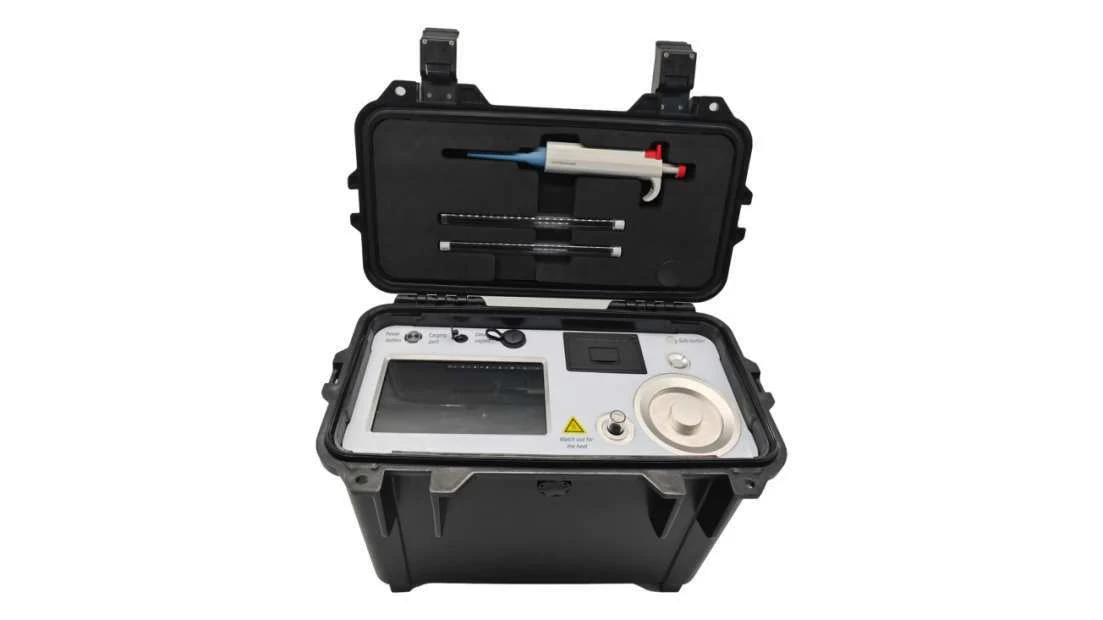
So the instrument question is really a temperature question. LubeServ's LSRT-PV100 holds the sample at a set temperature while it times the flow through a capillary, over a configurable 1 to 2,000 mm²/s: a result at the temperature the grade band is written in.
Its catalogue page adds two conditions that matter in an Indian summer: a working environment of 10 to 35 °C and a test temperature at least 5 °C above ambient. For a 40 °C test both mean a room at 35 °C or cooler; on a 38 °C afternoon, the case and the sample go somewhere cooler first.
Compare against the last fill
Two other field instruments, the LSDT100 viscosity pen and the falling-ball comparator, compare rather than certify. The pen reads at the sample's own temperature, between 0 and 60 °C, and its kinematic range tops out at 1,000 mm²/s. The same temperature line puts unmixed VG 320 above that at anything cooler than about 24 °C.
With either, warm the sample and the retained bottle of the last fill together and read both. That bottle is the reference that matters: the useful question is not whether this oil is VG 320 but how far the sump has moved from what went in. Keep a sealed bottle from every fill for exactly this morning.
What the manual has already decided
Once the reading is in, the gear maker's manual decides whether the mixture can stay. Flender's instructions are blunt: no mixing of oil types or makes, top-ups only with the oil already in the unit, and otherwise a complete change with flushing. The reason it gives is that the oils may not be compatible.
Two oils can blend completely and still be incompatible, because compatibility rests on the additives. Mobil says typical hydraulic oils lack the extreme-pressure properties of its Mobilgear 600 XP gear oils. The reading describes the film. It says nothing about what the extreme-pressure package in one oil and the anti-wear package in the other are doing to each other.
The manual also sets an in-service limit, a 40 °C viscosity within 10% of the oil's nominal value; whether the oil is still usable is for its manufacturer to decide. Other gear makers write other rules. The point is to read yours before the meeting, not after it.
Today or the planned stop
Under a rule like Flender's, the mixture needs changing. The viscosity result is evidence for the operating decision, not permission to keep running.
Outside the band, inside the band
- Below 288 mm²/s at 40 °C
- The result is outside the selected grade band. Flag that loss of viscosity when arranging the change and agreeing the immediate operating decision.
- 288 mm²/s or above
- A result inside the band does not clear the mixture or its additives. Any continued running needs a written disposition consistent with the gear maker's instructions.
The same instructions warn that oil running too hot can lose enough viscosity to cut its load-bearing capacity to an unacceptable level. A thinned sump starts nearer that edge: at 70 °C the 10% mixture is estimated at 60 mm²/s against 69 for the right oil, about an eighth less at the temperature the gears actually see.
A partial drain-and-refill looks like a compromise and rarely is one. Replacing half the sump with fresh VG 320 halves the hydraulic oil to 5% and lifts the estimate only to 293 mm²/s, barely inside the band, while leaving the two additive systems together in the box.
Where the manual leaves the decision to the oil supplier, send the file and ask for a written disposition.
What goes to the oil supplier
- The controlled reading and its test temperature
- The top-up record, with the litres
- Both product names
- The sump temperature history
- The gear maker's rule, from the manual
LubeServ's LubeMonitor programme can confirm the kinematic viscosity and viscosity index by routine oil analysis, and add TAN and elemental analysis if the supplier asks for them.
Before the afternoon meeting
The planner can walk into that meeting with three things on the table: a controlled reading run beside the retained bottle of the last fill, the fraction it implies written next to the four litres in the log, and the gear maker's lubrication page open at its rule.
The reading helps explain the mistake; it does not approve nine more days of running. Take the complete record to the responsible site team, gear maker and oil supplier for a written decision. Meanwhile, the VG 68 container leaves the gearbox trolley and the fill point gets its own labelled container.
The viscosity check was the cheapest part of this morning, and the part you would rather not repeat.
References
All blend, fraction and temperature figures are calculations from the stated inputs; the method and its limits are in the text.
View 13 technical references
- ASTM D7152-23, Standard Practice for Calculating Viscosity of a Blend of Petroleum Products, ASTM International. Public scope and significance.
- Viscosity Blending Equations, Lube-Tech No. 93, Boris Zhmud, Lube Magazine No. 121, June 2014.
- Saybolt Viscosity of Blends, Technologic Papers of the Bureau of Standards No. 164, Winslow H. Herschel, US Bureau of Standards, 1920. Introduction, section II and conclusions.
- Viscosity Grade (ISO VG, SAE), TotalEnergies Lubmarine glossary. ASTM D2422-24, Standard Classification of Industrial Fluid Lubricants by Viscosity System, ASTM International. Public scope and significance.
- Mobilgear 600 XP Series product data sheet and Mobil DTE 20 Ultra Series product data sheet, ExxonMobil, 10-2026. Typical properties.
- ASTM D341-20(2025), Standard Practice for Viscosity-Temperature Equations and Charts for Liquid Petroleum or Hydrocarbon Products, ASTM International. Public scope. Viscosity Index, R. David Whitby, STLE Tribology and Lubrication Technology, November 2012.
- LSRT-PV100 Portable Viscometer, LubeServ catalogue.
- LSDT100 Viscosity Pen, LubeServ catalogue.
- Viscosity comparator, LubeServ catalogue.
- Mixing of lubricants and additives, OELCHECK wiki.
- Using hydraulic oil in gear applications, ExxonMobil, 22 February 2016.
- Gear unit lubrication and gear unit preservation, BA 7300, Flender, version 07/2026. Pages 21, 23, 52 and 54.
- LubeMonitor programme, LubeServ.
New LubeServ articles
Get new LubeServ articles by email
We will email you only when a new article is published. Unsubscribe at any time.