
Choosing the Right Lubricant Is Not Enough
When a bearing or gearbox fails again, check what reached it, how it was applied and what the damage reveals. A different drum may leave the same cause in place.


In this article
In a case documented by SKF, a cement mill suffered repeated premature bearing failures. The equipment maker’s oil recommendation, the technician’s lubrication routine and the product named in the laboratory record did not agree. A sample from the container used to top up the mill measured less than 5% of the recommended viscosity and contained almost 1,000 ppm of iron.1
The investigation reached the container actually used on the machine. A purchase order or an approved product list could not have revealed what was inside it.
When a failure returns, follow that same line of inquiry. Establish what the machine required, what reached it and how it was applied. Then decide whether the lubricant needs changing.
01 / Failure evidence
Reconstruct the last failure before changing the next fill
A hot bearing is a symptom. Excess grease, inadequate lubrication, contamination and mechanical faults can all produce heat. SKF’s troubleshooting guidance treats these as separate possibilities, each requiring its own checks.2
Before a cleanout removes the evidence, assemble the failed component photographs, lubrication task history, oil or grease records and operating conditions. Include changes in speed, load, temperature, washdown and maintenance access. Retain samples and components using the procedure agreed with the laboratory or failure analyst.
If the evidence points to alignment, fits, electrical damage or overload, keep that investigation open. A lubricant change cannot be credited with correcting a fault it does not address.
02 / Product identity
Confirm the product at the lubrication point
Check the current equipment requirement against the actual duty. For a bearing, speed, load and operating temperature influence the viscosity needed at the contact. For a gearbox or hydraulic system, retain the equipment maker’s performance and compatibility requirements as well as the viscosity grade.2
With grease, NLGI grade describes consistency. It does not identify the viscosity of the base oil or make two greases interchangeable. Check the base oil, thickener, required performance and compatibility before a change.62
Now trace the approved product name and plant code through the purchase record, store location, dispensing tool and machine label. Match the written identity at every handoff. Colour can help recognition, but the readable product code must still be present.
A label establishes what a container is intended to hold. When its contents are uncertain, hold it and investigate. A viscosity result can expose a mismatch; it cannot, by itself, prove the complete formulation.
03 / Storage and transfer
Inspect what happens between the drum and the machine
Start at receipt. Compare the ordered product with the delivery label and batch record, then inspect seals, damage and leakage. For a critical asset, define the sampling, cleanliness and water acceptance requirements before the delivery arrives. The incoming oil checklist explains the release decision.
Keep the stock protected
Store lubricants in a designated area with intact labels and closed containers. Rotate older stock forward within the supplier’s shelf life guidance. ExxonMobil identifies moisture, dirty dispensing equipment, temperature exposure and mixing as avoidable causes of deterioration or contamination during storage and handling.3
Watch one complete top up
Follow the person doing the job. Inspect the vessel interior, hose, outlet and connection surfaces. Find out where the nozzle is left between tasks and whether the same equipment carries another lubricant. A closed lid provides little protection when dirt on the outlet enters with the next fill.
Specify a dedicated, labelled transfer vessel, protected connection surfaces and a fill arrangement suited to the machine. If filtration is required, select it for the fluid, contaminant, flow and target condition. Filtering the wrong oil is like sieving the wrong ingredient: removing particles does not create the required formulation.
04 / Application
Put quantity and interval on the work order
“Grease weekly” leaves the dose undefined. The instruction needs the point, exact product, quantity, interval, method and permitted machine state. SKF identifies grease type, quantity and application frequency as separate factors in relubrication.4
If a task specifies strokes, measure the output of that particular gun with that grease. Prime it, dispense a counted set of full strokes into a tared container and weigh the grease. Repeat to check consistency. The arithmetic below illustrates the conversion; it does not prescribe a dose for a bearing.
Convert a measured output into a task
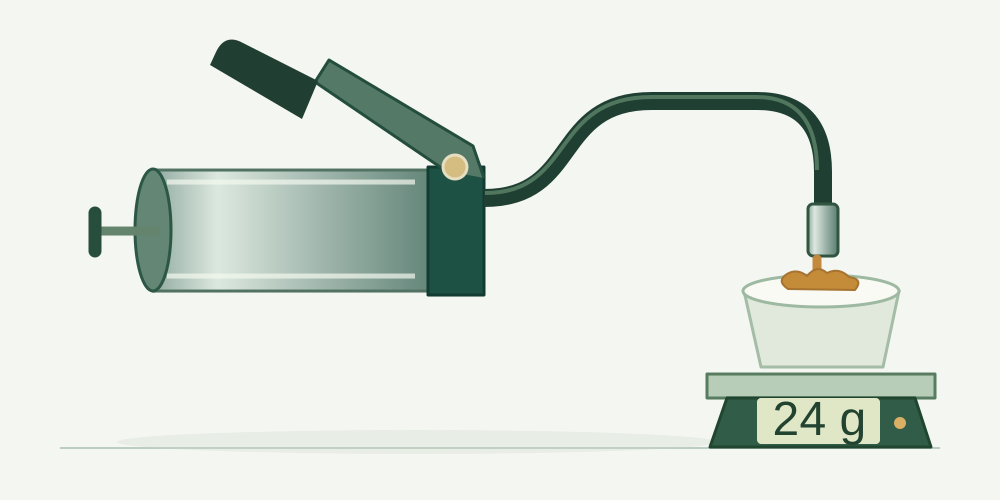
- Collected in 20 full strokes
- 24 g
- Output per full stroke
- 1.2 g24 ÷ 20
- If the approved dose is 6 g
- 5 strokes6 ÷ 1.2
Excess grease can raise temperature through churning. Too little can leave the contact inadequately supplied. Increasing the quantity to compensate for missed rounds changes the task and may introduce another problem.2
For oil, specify the level and the machine state in which it is checked. Follow the equipment instructions for running or stopped conditions, isolation and access. For automatic lubrication, verify the lubricant, delivery setting, line condition and arrival at the intended point before relying on the schedule.
05 / Verification
Define the evidence before closing the job
Choose the result that would support the correction and record the starting condition. A change to a transfer method calls for different evidence from a change to grease quantity. Set the review date by operating exposure and failure risk, with an owner responsible for interpreting the result.
| Change | Evidence to collect | Limit of the check |
|---|---|---|
| A new transfer container | Inspect its inside surfaces, lid and outlet. Compare suitable samples before and after transfer. | A new label does not establish that the container is clean. |
| A revised grease quantity | Measure gun output. Record the delivered amount, operating hours and machine response at comparable duty. | A completed task does not establish that grease reached the bearing. |
| A breather or seal correction | Check the installation and remaining openings. Trend water and particles separately against the asset limits. | Breather colour does not measure water in the oil. |
| A different lubricant | Document the compatibility review, conversion procedure and baseline. Compare the same operating duty after the change. | A short period without an alarm does not establish that the cause has been removed. |
A new transfer container
- Evidence to collect
- Inspect its inside surfaces, lid and outlet. Compare suitable samples before and after transfer.
- Limit of the check
- A new label does not establish that the container is clean.
A revised grease quantity
- Evidence to collect
- Measure gun output. Record the delivered amount, operating hours and machine response at comparable duty.
- Limit of the check
- A completed task does not establish that grease reached the bearing.
A breather or seal correction
- Evidence to collect
- Check the installation and remaining openings. Trend water and particles separately against the asset limits.
- Limit of the check
- Breather colour does not measure water in the oil.
A different lubricant
- Evidence to collect
- Document the compatibility review, conversion procedure and baseline. Compare the same operating duty after the change.
- Limit of the check
- A short period without an alarm does not establish that the cause has been removed.
For oil trends, keep the sampling point, procedure and operating conditions comparable. Record oil age, machine hours, additions, filtration and oil changes. A cleaner result after a fresh fill says something different from a cleaner result after the same oil has spent another month in service.5
A contaminated bottle or an inconsistent sample can mislead the investigation. Review the collection method when the result conflicts with other evidence. Use particle, water, viscosity and wear results as distinct measurements, interpreted with the laboratory and the machine history.
For the next repeat failure, leave the review with five recorded decisions: the suspected mechanism, the supporting evidence, the correction, the responsible person and the result to be checked. That record gives the next shift something specific to carry out and the reliability team something specific to test.
Technical reading
Sources and scope
The checks above combine manufacturer guidance with a practical review sequence. Equipment instructions govern the final lubricant, dose, interval, safe access and acceptance limits.
- SKF: Lubrication managementThe cement mill investigation on page 3 and the wider lubrication programme. The opening case is SKF’s published example.
- SKF: Bearing installation and maintenance guideLubricant selection, grease application and troubleshooting. See printed pages 89 to 100 and 105 to 118.
- ExxonMobil: Handling and storing lubricantsContainer protection, stock rotation, storage conditions and common contamination routes.
- SKF: Grease knowledge and sustainabilityThe relationship between grease type, quantity, application frequency and operating conditions.
- Mobil: Lubricant analysis fundamentals guideRepresentative samples, consistent collection and the equipment history needed to interpret trends.
- SKF: Rolling bearings catalogueLubrication chapter: grease properties, base oil viscosity and NLGI consistency.