
When Is the Filter Cart Finished?
The cart has been running for hours. Is the reservoir clean, or only the oil leaving the filter? The right sample tells you when the job is finished.
 By Deepika Dhir
Published
In this article
A clean sample from a filter cart can be the wrong result to close the job with. In the worked example below, oil leaving the filter starts at about 1,200 counted particles per millilitre while the reservoir still holds 12,000, both in the same 4 µm(c) and larger channel.
The filter is doing its job. The tank is not clean yet. That distinction is easy to lose when a cleanup starts without an agreed sample point or a result that will end the run.
Run as a temporary kidney loop, a cart can clean an in-service reservoir: it draws oil from the tank, passes it through its own filters and sends it back. Conditioning a new delivery before first fill is a separate job, covered in New Oil Is Not Proof of Clean Oil.
Write the finish line before you switch on
Put five things on the work order before anyone fetches the cart:
- The target cleanliness code for this machine, and its source
- The sample point, and the machine state for every sample (running at normal temperature, or stopped)
- The counting method: the same laboratory or portable counter every time
- The cart, its element and the oil it is kept for
- The stop rule: the result that ends the job, and what happens if the count stops falling first
The target belongs to the machine, not the cart. Donaldson's hydraulic filter catalogue names the component manufacturer's published specification as the best source for it (p. 33); where none exists, ISO 12669 describes a method for working one out.
The target is usually an ISO 4406 code: three numbers, one each for the count per millilitre of particles of 4, 6 and 14 µm(c) and larger (Donaldson catalogue, p. 29). The (c) means the sizes come from a counter calibrated to ISO 11171 (p. 31). Each step up the scale roughly doubles the count.
Why the count falls quickly, then slowly
The cleaner oil a cart returns mixes with the rest of the tank, so each pass (one reservoir volume through the cart) removes the same fraction of what is left. The count falls quickly at first, then more slowly as there is less to catch.
That fraction depends on the element's filtration ratio, or beta: the count of particles of a stated size and larger upstream of the element divided by the count downstream, measured in the ISO 16889 multi-pass test. A beta of 10 means 90% stopped; 1,000 means 99.9% (Donaldson catalogue, pp. 30 and 32).
Treat it as a laboratory figure: Donaldson notes that beta ratings are measured under steady flow with an artificial contaminant, and that the real proof is how clean the filter keeps the fluid in service (p. 31).
Meanwhile, dirt keeps arriving: past leaky seals, through open reservoirs, during servicing and from wear inside the machine (Donaldson on contamination).
So the count settles where the cart removes particles as fast as they arrive, a level set by how fast dirt gets in or is generated as well as by the filter (Donaldson catalogue, p. 33). A Silesian University of Technology team reported the same levelling off in flushing tests on a hydraulic system (Klarecki and Rabsztyn, 2019).
Cart makers plan the run in passes. Donaldson gives the time as reservoir volume times seven, divided by cart flow, and says it varies with starting cleanliness, ingress and element (filter cart brochure, p. 4). Lubrication Engineers (LE), maker of the Xtract cart, says to circulate the whole volume at least seven times (Xtract manual, p. 7).
One cart, three set-ups
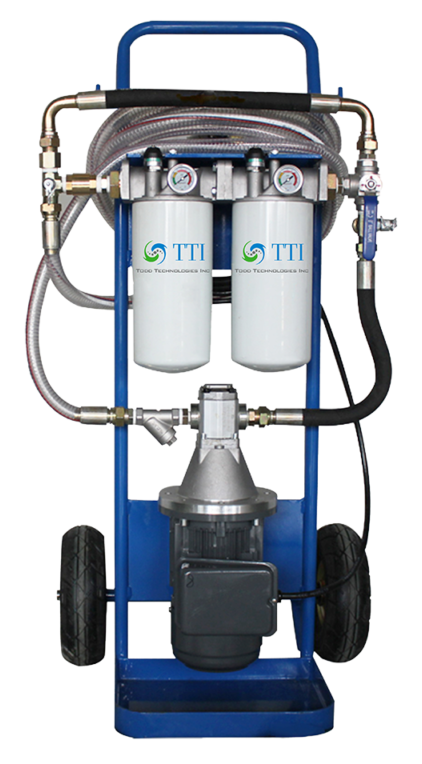
Every number in this worked example is an assumption chosen to show the mechanism, not plant data or the rating of any real cart, including the one pictured above.
Take a 400-litre hydraulic reservoir at 12,000 particles of 4 µm(c) and larger per millilitre, code 21 in that channel, with a target of code 18: 2,500 or fewer (WIX Filters code table).
The cart moves 20 litres a minute, one pass every 20 minutes, and its element stops nine of every ten counted particles (a beta of 10). The oil mixes perfectly and the machine's own filters are ignored. New dirt arrives at a steady rate, set low enough that this cart, with its hoses well apart, would hold the count near 300 per millilitre.
THE SAME CART. THREE SET-UPS.
Running time is not the finish line.
Hoses apart, little new dirt
37 minAbout two passes to target.
Return beside the suction
135 minNearly seven passes to target.
Ten times the incoming dirt
Not reachedLevels off above the target.
Show the numbers
| Case | Time to target | Code at seven passes | Steady level |
|---|---|---|---|
| Hoses apart, little new dirt | About 37 minutes (1.9 passes) | 321 per mL, code 16 | 300 per mL, code 15 |
| Return beside the suction | About 135 minutes (6.7 passes) | 2,381 per mL, code 18 | 930 per mL, code 17 |
| Hoses apart, ten times the dirt | Never reaches it | 3,017 per mL, code 19 | 3,000 per mL, code 19 |
Hoses apart, little new dirt. The count reaches the target in about 37 minutes, under two passes, each code step at first taking about 16 minutes. It then settles in code 15, around 300 per millilitre.
Return beside the suction. Now seven-tenths of the cart's intake is oil it has just cleaned (an assumed share; in a real tank it depends on the hose positions and how the oil moves). With the same small ingress, the cart needs about two and a quarter hours to reach the target. It settles higher, a little over 900 per millilitre, because less of its flow does useful work.
Hoses apart, ten times the dirt. This stands for a reservoir with a large source of dirt still open, such as an uncovered hatch in a dusty bay. The count levels off near 3,000 per millilitre, in code 19, and never reaches code 18.
Seven passes take 140 minutes here. By then the first set-up is well below the target, the second has only just crept under it (a slightly worse hose position would have left it above), and the third will never get there. The clock reads the same for all three.
Real tanks do not mix perfectly. Dead corners slow the cleanup, and some oil short-circuits from return to suction as in the second case, so read the example for the shape of the curves rather than its times. Use passes to plan when to sample, and the sample to decide.
Connect through closed ports, with the hoses apart
Hoses pushed through an open filler add an opening to a job meant to remove dirt, and they tend to end up side by side, the return next to the suction. Fixed quick-connect ports, placed apart, deal with both. LE's manual recommends them for filtration, with the fittings wiped, dust covers kept on, and suction and return at opposite ends where possible (p. 7).
The cart connects to the reservoir being filtered, never to a pressure line (p. 7). A suction wand pushed through an opening can sink into settled sludge, so the manual also recommends a strainer ahead of the pump (p. 14).
LubeServ's shop carries quick-connect kits with covers, listed as ISO 7241-1 Series B, and Luneta Hub kits. Luneta says the Hub fits at the drain port or anywhere below the oil level, with side ports that can take a filter cart connection (The Hub).
Before the cart arrives, check that its hose ends match the machine's ports in series and size. ISO 7241 sets interface dimensions for two coupling series, A and B.
Machine state matters too. On a running machine, LE's manual limits cart flow to 10% of the sump volume per minute; on a stopped one, it suggests as much flow as is reasonable, to keep the tank stirred (p. 7).
Keep the cart for one oil, or flush it thoroughly between oils. As Where Clean Oil Gets Dirty notes, oil left in a shared cart can carry into the next machine, and LE says separate carts are usually more cost-effective (pp. 6 and 7).
Stand the cart level with or below the machine and earth it properly, as the manual asks. It also says that model is not approved for explosive atmospheres (pp. 3 and 6), so in a refinery, petrochemical unit or other hazardous area, check your cart's rating before it goes in.
Watch the gauges and the oil temperature
A cart's flow depends mostly on viscosity, and its elements add restriction as they fill (LE manual, p. 5). Donaldson's cart for oil up to 1,700 cSt is rated at 2 US gallons (about 7.6 litres) a minute, against 10.4 (about 39 litres) for its version for oil up to 108 cSt, so each pass takes about five times as long (brochure, p. 3).
Temperature moves viscosity a long way: Donaldson gives ISO VG 32 hydraulic oil as 86.7 cSt at 20 °C, and advises choosing the cart for the viscosity at the temperature you will actually run (brochure, p. 3). Check heavy gear oils this way, and any oil on a cold morning.
TTI, whose cart is pictured above, describes its carts as made for cleaning existing systems and transferring oil in small to mid-sized mineral-oil applications (TTI filter carts). Get the flow, element rating and viscosity range for your exact model before planning the run.
Log each gauge reading with the oil temperature. At steady temperature, a pressure drop across the element that keeps rising usually means the element is filling with the dirt you are removing; cold, thick oil raises it too (Donaldson catalogue, pp. 24 and 25). Change the element at the maker's stated point; on the Xtract cart, the indicators only work while the pump runs (p. 9).
Watch the bypass too. Donaldson lists a setting of 25 psid (1.7 bar across the element) for its cart's pressure filters (brochure, p. 3). At that setting a valve opens and some or all of the oil goes round the element instead of through it (Donaldson catalogue, p. 25; Sauer-Danfoss patent US 7,438,800 B2), back to the tank as dirty as it came.
Sample the reservoir, the same way each time
Some carts carry their own sample valves. Customised Xtract carts have one before the filters and one after (LE manual, p. 8), and Donaldson says its cart's valve monitors filter performance and oil cleanliness (brochure, p. 2).
A sample taken after the element shows what the element lets through, not the oil in the tank. In the worked example with the hoses apart, oil leaving the element at the start would count about 1,200 per millilitre (code 17) while the tank is at 12,000 (code 21).
To judge the reservoir, sample where the oil is moving and well mixed, often called the live zone. ISO 4021 prefers a main flow line and treats the reservoir as the fallback when no suitable sampler is fitted.
If the cart is the only access, LE's manual says to circulate with the filters bypassed and sample upstream of them (p. 8). A fixed valve with a pilot tube into the live zone makes the point repeatable.
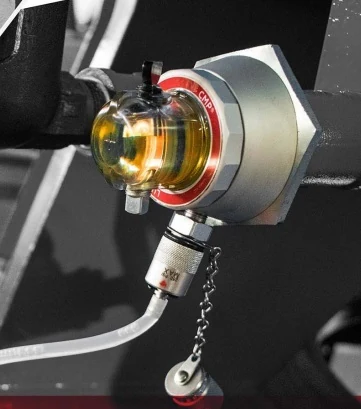
Take a baseline before the cart starts, further samples at intervals set in passes, and a final one after, each with the same point, machine state, sample-valve flush and counting method.
ISO 11500, the standard for automatic particle counting by light extinction, lists monitoring a flushing operation among its uses but covers clear, single-phase liquids only. LubeServ's WJS-150 portable particle counter, supplied for checking cleanliness on site during filtration work, counts the same way and reports in ISO 4406 codes, so the same limit applies.
Check with the laboratory before trusting any count from a cloudy or wet sample. If the job will be accepted on a laboratory result, use the laboratory for the baseline too.
| Reading | What it tells you | What it cannot tell you alone |
|---|---|---|
| Run time or passes | How long the cart has worked; when to sample next | Whether the reservoir has reached its target |
| Cart pressure gauges | How full the element is (read at a steady oil temperature) and how near it is to the bypass setting | How clean the oil in the tank is |
| Sample after the element | What the element lets through | The condition of the oil in the tank |
| Live-zone sample, same state and method | The tank's cleanliness against the target | Where new dirt comes from |
| Two or three live-zone samples in a row | Whether the count is still falling or has levelled off | The ingress route, which needs an inspection |
Stop on the target, or stop and find the source
Read the live-zone samples as a short trend. It points to one of three decisions.
The target is met
Stop the cart and record the result with the passes, gauge readings, oil temperature and element. After a period of normal running, set in advance, take one more sample from the same point. A count that drifts back up suggests dirt is still getting in.
The count is still falling
Keep going, and plan the next sample by passes. If each code step down is taking about the same number of passes, the count is still far above the level where removal and incoming dirt balance.
The count has levelled off above the target
Two or three comparable samples that barely change above the target show no clear further improvement. They do not identify the cause. Check the cart's actual flow, element condition, bypass indication and hose positions, then inspect where dirt may be entering or being generated.
Look for the source: breathers and vents (air drawn into a vented tank carries dirt in, as Every Reservoir Breathes explains), hatches and fill points, seals and the top-up routine. A reservoir that keeps calling for the cart needs better protection against dirt getting in, or permanent off-line filtration.
Check water and additives separately
A particle element does not dry oil. Donaldson offers a water-absorbing element for its cart to remove free water, the water that has separated from the oil rather than staying dissolved or emulsified in it (brochure, p. 4). Dissolved water needs another process, such as the vacuum dehydrators HYDAC describes for removing free and dissolved water (HYDAC dehydrators).
Repeated filtration can also remove some additives, foam inhibitor in particular. Chevron's ISOCLEAN bulletin reports foam inhibitor sticking to filter media, even media rated coarser than the additive droplets, and oils failing foam or water-separation tests after repeated passes (pp. 2 to 5).
If your oil relies on foam control or water separation, agree the element and running temperature with the lubricant supplier, and add those tests to the next analysis. LubeServ's LubeMonitor programme lists foam and demulsibility (water separation) among its specialist tests, where applicable.
Start with one reservoir
Pick one reservoir whose last report was above target. Before the cart next goes out, agree the five items, arrange suitable closed connections and take the baseline from the point you will use at the end. Keep the run log with that machine's oil analysis history.
The useful handover is more than a running time: the connection arrangement, comparable counts and the result against the target. Over successive cleanups, those records can help separate a reservoir that responds to filtration from one that needs an investigation into recurring dirt. A clean outlet sample alone cannot make that distinction.
References
View 18 technical references
- Donaldson Company. Hydraulic Filters Catalog, technical reference, pp. 24 to 33. Pressure drop rising with dirt load and viscosity, and bypass operation (pp. 24 and 25); ISO 4406 table (p. 29); beta ratio definition and efficiency table (pp. 30 and 32); laboratory caution on beta ratings and the (c) calibration note (p. 31); contamination level set by ingress as well as the filter, and required cleanliness from the component manufacturer (p. 33).
- Donaldson Company. Filter Cart for Off-Line Filtration, brochure F111360 ENG (5/15). Seven-pass planning formula, viscosity versions and flow ratings, bypass settings, sample valve, water-absorbing element.
- Donaldson Company. 6 Common Types of Hydraulic Fluid Contamination and How to Prevent Them.
- Lubrication Engineers, Inc. Xtract Standard Filter Cart Owner's Manual, LEX-SFCOM_142 06-17. Offline filtration tips and dedicated carts (p. 7), sampling through a cart and its two sample valves (p. 8), kidney-loop procedure (p. 9), sample valves and strainer (p. 14), safety, placement, restrictions and flushing between oils (pp. 3 and 6), flow and viscosity (p. 5).
- ISO. ISO 4406:2021, Hydraulic fluid power: Fluids: Method for coding the level of contamination by solid particles. Public scope page read; confirmed current at its 2026 review.
- WIX Filters, WIX Institute of Filtration Technology. ISO Cleanliness Code. ISO 4406 scale table.
- ISO. ISO 16889:2022, Hydraulic fluid power: Filters: Multi-pass method for evaluating filtration performance of a filter element. Public scope page read.
- ISO. ISO 12669:2017, Hydraulic fluid power: Method for determining the required cleanliness level (RCL) of a system. Public scope page read.
- ISO. ISO 4021:1992, Hydraulic fluid power: Particulate contamination analysis: Extraction of fluid samples from lines of an operating system. Public scope page read. A third edition was at the final approval stage in October 2026; its public scope text is unchanged.
- ISO. ISO 11500:2022, Hydraulic fluid power: Determination of the particulate contamination level of a liquid sample by automatic particle counting using the light-extinction principle, with Amendment 1:2026. Public scope page read.
- ISO. ISO 7241:2023, Hydraulic fluid power: Dimensions and requirements of quick-action couplings. Public scope page read.
- Klarecki, K. and Rabsztyn, D. (Silesian University of Technology). Experimental Verification of the Filtration Phenomena in Hydraulic Systems. In Mechatronics 2017: Ideas for Industrial Applications, Advances in Intelligent Systems and Computing, vol. 934, Springer, 2019, pp. 220 to 230. Abstract read.
- Luneta. The Hub and Condition Monitoring Pod. Installation location, side ports and live-zone sampling valve; the pod's sampling valve and pilot tube.
- Chevron Lubricants. Impacts of Filtration on New Lubricant Performance, ISOCLEAN technical bulletin, 2021.
- HYDAC. Oil dehydrator systems. Product descriptions of free and dissolved water removal.
- Sauer-Danfoss Inc. (now Danfoss Power Solutions). US 7,438,800 B2, Arrangement for filtering hydraulic fluid, 2008. Describes a hydraulic filter bypass that opens on rising pressure from a dirty element and sends part of the flow downstream unfiltered; cited for the mechanism only.
- Todd Technologies Inc. Filter Carts. Intended uses of TTI filter carts.
- LubeServ. Contamination Removal, Filter Carts, quick connects and covers, Luneta Hub kits, Condition Monitoring Pod, portable particle counter and LubeMonitor programme. Product and service pages, read 19 October 2026.
Standards are cited from their public ISO scope pages; the full texts were not read. Use the cart, element and machine manuals for the equipment in front of you, and the cleanliness target written for your machine.
New LubeServ articles
Get new LubeServ articles by email
We will email you only when a new article is published. Unsubscribe at any time.