
Read the Drain Bowl Before You Drain It
The layer in a drain bowl is evidence, and one turn of the valve sends it to the drip tray. Read the bowl in the same machine state each time, record what it shows, and let that record decide when the oil needs a laboratory test.

In this article
On a routine round, a thin layer sits at the bottom of the clear bowl under a gearbox drain. Someone opens the valve for a few seconds and the round moves on. The bowl looks clean again, and nobody has written down how deep the layer was or what it looked like.
That layer is worth reading first. Free water left in a stopped machine can etch bearing surfaces, and water in oil can lead to corrosion, wear and weaker additive performance. 1 2
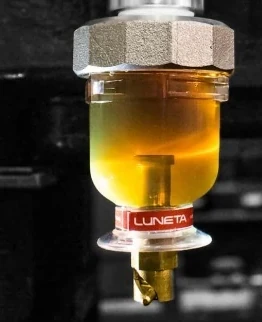
A clear BS&W bowl, short for bottom sediment and water, lets you see four things at the drain port without opening the machine: a water layer, haze, sludge or grit, and debris on the magnet.
It suits gearboxes, bearing housings and small circulating reservoirs on mineral or synthetic hydrocarbon oil. A few fluids, such as phosphate esters and some PAG gear oils, hide water from a bottom bowl; they are listed in the box “When a bottom bowl cannot show the water”.
A clear bowl shows what has settled. It does not prove the oil is dry.
Why water sinks to the bowl
The bowl works because of density. A litre of mineral gear oil such as Mobilgear 600 XP weighs about 0.88 to 0.91 kg, and ExxonMobil's synthetic Mobil SHC Gear oils about 0.86 to 0.87 kg. 3 4 A litre of water is close to 1 kg, so when the oil is still, free water is heavier and sinks. 5 6
Not all water in oil is free water. Oil holds some water dissolved in it, invisibly, up to a saturation limit set by the oil, its additives and its temperature. Above that limit, water shows as fine droplets that make the oil hazy, or as free water in its own layer. 5 6 As the oil cools, the limit falls, and dissolved water can come back out as fine haze after a stop. 5 7
Separation also takes time. Stokes' law, which describes settling in a still liquid, says settling speed rises with the square of droplet size and falls as viscosity rises. 8 A droplet twice the diameter settles about four times faster, and cold, thick gear oil holds small droplets far longer than warm, thin oil. A bowl checked minutes after a stop can show much less than the same bowl after a night at rest.
Here is an illustrative case, not a reported one: a large gear drive on ISO VG 320 mineral gear oil, with a water-cooled oil cooler and a bowl at its drain. It runs all week, apart from the odd short stop, and stands idle every weekend.
Read it in the same state
Because settling depends on time and temperature, a reading can only be compared with another taken in the same machine state. Choose that state for each bowl, write it on the route card, for example “before start-up after an overnight stop”, and keep to it. A change in the bowl should then mean a change in the machine, not in the timing of the round. Luneta, which makes the bowl, recommends a daily check. 9 The frequency for each machine is the plant's decision.
At the bowl, before you open the valve
- Shine a torch through the bowl from the side and from below. 10
- Photograph it with the asset tag in the frame.
- Hold a small steel rule against the bowl and note how many millimetres the top of any layer sits above the top edge of the red band. If the layer is too thin to rise above the band and you can see it only from below, write “below band”.
- Look at the magnet through the bowl wall, and note any haze in the oil above the layer.
The bowl shows only what reaches the port: if the port sits above the sump floor, some water can pool below it unseen.
For the gear drive, the route card now says: check daily at the start of the shift, note whether the drive was running or stopped, and note the date of the last drain. Each Monday pre-start reading is compared with the previous Monday's. That reading follows the longest rest of the week, so water and debris have had the most time to settle into the bowl.
What the bowl can show
Use the table as a starting point. The machine maker's instructions, the plant procedure and your oil analysis programme come first.
| In the bowl | Likely cause | Do next | Does not prove |
|---|---|---|---|
| A separate layer at the base | Usually free water; less often glycol, another fluid or microbial growth | Photograph it, drain it into a clear jar and note the amount | That the oil above is dry |
| Milky or hazy oil | Emulsified water or air; in cold oil also wax or additive dropout | Note whether it clears on standing, then sample from the normal point for a water test | How much water, or which cause |
| Sludge or grit on the floor | Dirt, rust, wear debris or oxidised oil | Keep the deposit; check the breather, seals, any filter and recent work | Which of these it is |
| Fuzz or clumps on the magnet | Iron or steel wear debris | Photograph it at every reading and compare with the last photo | Anything about bronze, aluminium or white-metal wear |
| Nothing visible | Nothing heavy has settled since the last drain | Record “clear” and the machine state | That the oil is clean and dry |
Reading the bowl
A separate layer at the base
- Likely cause
- Usually free water; less often glycol, another fluid or microbial growth
- Do next
- Photograph it, drain it into a clear jar and note the amount
- Does not prove
- That the oil above is dry
Milky or hazy oil
- Likely cause
- Emulsified water or air; in cold oil also wax or additive dropout
- Do next
- Note whether it clears on standing, then sample from the normal point for a water test
- Does not prove
- How much water, or which cause
Sludge or grit on the floor
- Likely cause
- Dirt, rust, wear debris or oxidised oil
- Do next
- Keep the deposit; check the breather, seals, any filter and recent work
- Does not prove
- Which of these it is
Fuzz or clumps on the magnet
- Likely cause
- Iron or steel wear debris
- Do next
- Photograph it at every reading and compare with the last photo
- Does not prove
- Anything about bronze, aluminium or white-metal wear
Nothing visible
- Likely cause
- Nothing heavy has settled since the last drain
- Do next
- Record “clear” and the machine state
- Does not prove
- That the oil is clean and dry
Haze in the oil
Haze has several possible causes. Luneta's guide for its Condition Monitoring Pod lists air, emulsified water and glycol for milky oil, and air, water, wax, additive dropout and mixed oils for slight haze. It says to confirm the cause by oil analysis. 10
If haze that used to clear on standing now stays, ask the laboratory for a water separability test as well, because an oil sheds water less readily as it oxidises or picks up contamination. 5
The usual test is ASTM D1401, or D2711 for heavy gear oils too thick to mix properly in the D1401 test. 11 12 Compare a D1401 result with the typical new-oil figure on the data sheet: new Mobilgear 600 XP takes 25 to 30 minutes at 82 °C to separate 37 mL of water, depending on grade. 3 A used oil that takes clearly longer is holding on to water.
Debris on the magnet
Magnet debris only means something against the same machine's history. Luneta's guide, written for the pod's magnet, grades debris from light fuzz through whiskers to heavy clumping. Light fuzz can be normal; heavy clumping should always go to the laboratory. 10 The bowl magnet keeps the iron and steel debris it catches until someone cleans it, so judge that debris, like the water layer, by how fast it builds up between photographs.
Some debris is expected after new parts are fitted and usually decreases once they have run in. 13 ASTM's guide to analysing wear particles under a microscope notes that many gearboxes produce some severe-wear particles throughout their service life, so judge each gearbox against its own history. 14 The magnet sits on the drain valve, so cleaning it means removing the valve: do that only with the sump drained, for example at an oil change. 15
A clean magnet says nothing about a bronze worm wheel or a white-metal bearing, because those metals are not magnetic. 16 Look for metallic grains on the floor of the bowl instead, and send them to the laboratory if they appear.
When a bottom bowl cannot show the water
- Phosphate ester fire-resistant fluids such as Fyrquel EHC-N, with a specific gravity of about 1.145, are denser than water, so water separates at the surface. 5 17
- Mobil Glygoyle, a PAG gear oil, is about 1.08 kg per litre, so water stays on top; PAG oils also absorb more water than mineral oil. 18
- Water-glycol hydraulic fluids are about 40 to 42 percent water by design in a typical Dow formulation, so water is part of the fluid and does not settle out as a layer. 19
On these three fluids, an empty-looking bowl tells you very little about water. Follow the fluid supplier's method for checking it, and check the density of any other PAG with its supplier. Some detergent hydraulic oils of the HLPD type are also made to hold small amounts of water in suspension, so on them, too, an empty bowl does not prove the oil is dry. 5
Drain it with a record
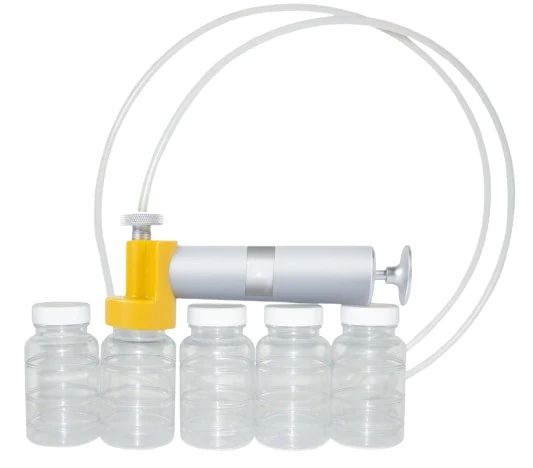
Drain the bowl when it shows a layer or deposit, after you have read and photographed it. Do it under the plant's isolation and permit procedure, with the gloves and eye protection it specifies, and stand clear of the stream if the oil is warm. Use a clean, clear jar so you can see what comes out.
On the Luneta bowl, push the valve arms up and twist to open the valve, hold it open until clean oil has refilled the bowl, then close it. 9 20 Stay at the valve with a hand on it the whole time it is open. Turned fully, the valve locks open, which Luneta says is useful for draining the whole reservoir, so a valve left locked open can empty the gearbox. 9 15
Then check the oil level, because oil leaves with the water, and top up through the plant's normal procedure. LubeServ's guide to how much oil to add when the level is low covers the method. Collect the drained oil and water for disposal through the site's waste procedure, not into a floor drain.
What to write down
- Date, time, asset and the machine state when the bowl was read
- When the bowl was last drained
- What the bowl showed: height of any layer above the red band in millimetres, or “below band”, its appearance and the photo reference
- What was on the magnet
- Roughly how much came out, what it was, and who did the work
Do not send anything drained from the bowl as an oil sample. Luneta says the bowl's contents do not represent the oil at the gears, 9 and the US Bureau of Reclamation's lubrication manual says drain samples in general are likely to carry more contaminants than the oil that reaches the bearing. 21
A sample for trending belongs at a live-zone point, where the oil is moving and well mixed. That can be a supply line after the pump and before any filter, or a sampling tube that reaches into the middle of the sump. Draw it in the same machine state every time, ideally with the machine running. The bowl, by contrast, is best read at rest. 21 Where Clean Oil Gets Dirty explains how to keep routine samples comparable.
When water keeps returning
A single layer after a known event, such as a hose-down near an open fill cap, has a clear cause: record it, close the cap and check that the layer does not return at the next reading. A layer that keeps coming back is different.
Draining removes only the free water that has reached the bowl; water dissolved in the oil or held as fine haze stays behind, and cooling can push more of it out. 5 7 In thick gear oil that haze settles slowly, so a layer that is back at every reading usually means fresh water is getting in.
The usual routes in are:
- Humid air drawn in through vents and breathers as the machine warms and cools, then condensing inside (see The Breather Changed Colour)
- Washdown water, or steam cleaning that forces moisture in through the breather
- Worn or damaged seals, and fill points left open or poorly closed
- A leak inside a water-cooled oil cooler or heat exchanger
- Water carried in during top-ups, oil changes and sampling 5 6
Three checks when the water returns
- Send a live-zone sample for a Karl Fischer water test. 2 Draw it while the drive runs at normal temperature, after flushing the sampling point by the plant's method. 21
- Compare oil-side and water-side pressures as close to the cooler as you can, with the drive running and again with the oil pump stopped and the cooling water still on. Water can leak into the oil only while the water pressure at the leak is higher than the oil pressure there. For the gear drive, if the cooling water stays on over the weekend stop, a leaking cooler has the whole weekend to push water into the oil, just before the Monday reading.
- Check the breather, the seals and the washdown routine around the gearbox.
An internal cooler leak is hard to pin down because nothing drips outside the machine. Reliability Engine's article The Heat Exchanger Leak That Leaves No Puddle works through the same problem on data-centre liquid-cooling loops. Its method carries over to an oil cooler: read the pressure check above together with the oil level, the cooling-water make-up record, a sample from each side, and the maintenance and fill history.
Choose and fit a bowl
If a machine does not have a bowl yet, these details decide whether one will work. On a critical machine, agree any change to its drain with the machine's owner first.
- Fit it at a drain-level port. Luneta makes the bowl with 3/8, 1/2, 3/4, 1 and 1-1/2 inch NPT male threads, 9 22 and allows a bushing to change the thread. 20 Check whether the port is NPT or BSP before ordering.
- Stay inside the ratings. Up to 93 °C and about 4.5 bar (65 psi), away from moving machine surfaces, shock, fluid surge and foot traffic. 9
- Match the size to the oil. Luneta does not recommend the 3/8 inch bowl with high-viscosity oil, because thick oil can seal over the top of the bowl and prevent proper flow through it. 20 A bowl that never refreshes shows stale contents.
- Check compatibility. The bowl is made of Tritan with Viton seals and metal fittings, and Luneta lists cleaning solvents to avoid. 9 22 Luneta flags phosphate esters as possibly marginal for its pod, which uses similar materials, so confirm unusual fluids with the supplier. 20
- Tighten it correctly. On the smaller sizes, tighten on the metal thread reducer, not the plastic hex. The 1-1/2 inch bowl screws in on its own moulded thread. Use a sealant suited to plastic threads rather than PTFE tape, and do not overtighten. 9 22
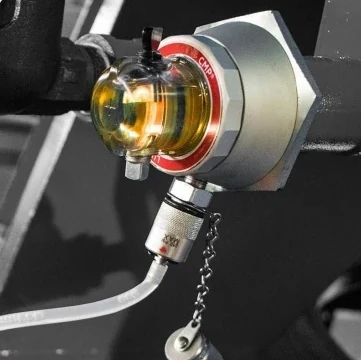
A Condition Monitoring Pod complements the bowl. It sits at the oil-level port, where its sight glass shows level, colour and clarity while the machine runs, and its pilot tube draws a sample from inside the oil rather than from the bottom. It also carries a magnetic plug and a corrosion indicator. 10 23 On a critical gearbox the bowl gives a quick daily look at what settles, and the pod gives a proper sampling point.
Begin at the next round
Pick one machine that already has a bowl. Write its reading condition on the route card, add the date of the last drain to the record, and photograph the bowl before every drain. For the gear drive, four Monday photographs would show whether the layer comes back at the same depth, grows, or stops once one source is dealt with: the breather, the washdown routine or the cooler.
The bowl will not give you a water content. Its record tells you when to send a sample, and it gives the laboratory result a history to compare it with.
Drain bowl questions
How much does a drain bowl hold?
About 30 mL (1 fl oz), according to Luneta's 2017 specification sheet for its 1/2 to 1-1/2 inch bowls. 24 In a 100 litre sump, a bowl full of free water is about 300 ppm by volume. Judge the bowl by whether the layer comes back and how quickly, and compare any laboratory result with the limit set by your oil supplier or laboratory.
Does the bowl come with a magnet?
Current Luneta bowls do. The Rev 5125 specification sheet lists a brass drain valve with a neodymium magnet, 22 and the magnet stands about 13 mm (half an inch) above the valve surface so settled sludge does not bury it. 15 Luneta's installation steps include removing the protective red cap from the magnet, 9 so check that the cap is off on any bowl you inherit. Older bowls may have no magnet at all: Luneta's 2017 sheet lists it as optional. 24
Is the crackle test enough to check for water?
Only as a quick first check. A hot-plate crackle test can show that free or emulsified water is present, but it gives no quantity and misses low levels; Fluid Life puts its range at roughly 250 ppm and above. 6 Wear eye protection, because hot oil can spit. 21 For a number, ask the laboratory for a Karl Fischer test. If the oil is an EP gear oil, ask which Karl Fischer procedure the laboratory uses. Sulfur compounds in the oil can interfere with the test, and ASTM D6304 also covers driving the water off by heat first. 2
What if the machine never stops?
Water and debris still reach the bowl while the machine runs. 9 21 Movement keeps more of them in suspension, though, so less settles. 6 20 Read the bowl at the same point in the shift with the machine running, record it as a running reading, and add a stopped reading at every planned shutdown. Compare running readings only with running readings.
References
View 24 technical references
- SKF. Bearing damage and failure analysis (PDF).
- ASTM D6304-25. Water in petroleum products, lubricating oils and additives by coulometric Karl Fischer titration.
- ExxonMobil. Mobilgear 600 XP Series product data sheet.
- ExxonMobil. Mobil SHC Gear Series product data sheet.
- HYDAC. Water in operating fluids.
- Fluid Life. The impact of water contamination on lubricants (PDF).
- Pall. HNP023 Series oil purifier data sheet (PDF).
- Alfa Laval. Technical information for bilge water treatment, PureBilge, page 9 (PDF).
- Luneta. The Bowl: BS&W sight glass, specifications, installation, usage and warnings.
- Luneta. Lubricant inspection and troubleshooting (written for the Condition Monitoring Pod).
- ASTM D1401-21. Water separability of petroleum oils and synthetic fluids.
- ASTM D2711-22. Demulsibility characteristics of lubricating oils.
- Machinery Lubrication (Noria). Magnetic plug inspection enhances condition-based maintenance.
- ASTM D7690-24. Microscopic characterization of particles from in-service lubricants by analytical ferrography.
- Luneta. Magnetic oil drain valve.
- Machinery Lubrication (Noria). Magnetic filtration applications and benefits.
- ICL. Fyrquel EHC-N electro-hydraulic control fluid, 2015 product bulletin (PDF).
- ExxonMobil. Mobil Glygoyle Series.
- Dow. UCON Lubricant 75-H Series base stocks, technical data sheet (PDF download).
- Luneta. Frequently asked questions: Bowl and Condition Monitoring Pod.
- US Bureau of Reclamation. FIST Volume 2-4, Lubrication of Equipment, May 2024 revision (PDF).
- Luneta. Bowl specification sheet, Rev 5125 (PDF).
- Luneta. Condition Monitoring Pod specification sheet (PDF).
- Luneta. Bowl specification sheet, 2017 (PDF).
New LubeServ articles
Get new LubeServ articles by email
We will email you only when a new article is published. Unsubscribe at any time.